Firms stay confident in their own prospects despite cloudy economic outlook
Firms’ confidence in their own prospects in the region improved in November although they are less optimistic on the economic outlook. Despite the cool reception to the Autumn Budget, a business barometer survey of 85 firms in the region from Lloyds – which was taken taken between 1st-15th November, after the Chancellor’s statement – showed that companies’ confidence in their own business prospects in the East of England rose 23 points to 72 per cent. But optimism in the region on the economy fell by one point to 25 pc. Kirsty Sadler, regional director for the East of England at Lloyds, said: “Business confidence in the East is now above the UK average, driven by growing confidence from the region’s businesses in their own trading prospects. Firms will now be looking to translate this optimism into action – whether that’s by launching new products, breaking into new markets or developing new skills.” Overall, national business confidence in the region rose by ten points during November to 48pc, compared to a slight dip nationally to 41pc although this was well above the long term average. Manufacturing firms saw the first rise in trading prospects in four months and construction and services businesses signalled stronger growth outlook but retail weakened.
Work completes on ‘pivotal’ £35 million offshore energy hub in Lowestoft

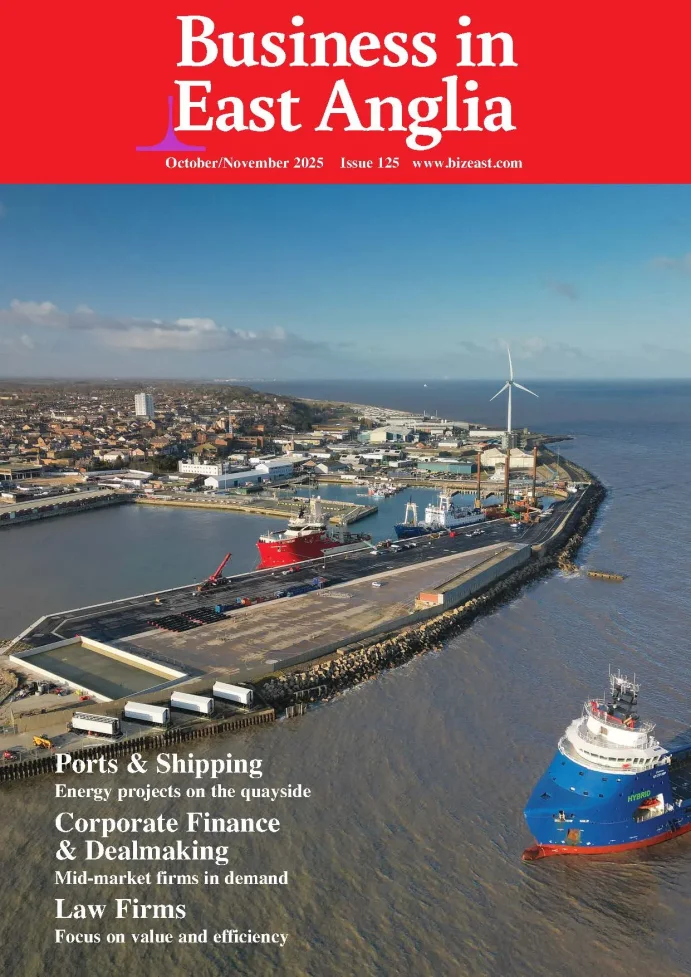
Port operator ABP has completed work on the Lowestoft Eastern Energy Facility (LEEF), the £35 million facility which has been purpose-built to meet the growing demands of the Southern North Sea offshore energy industry. LEEF will support operations and maintenance activities and construction phase needs. Julian Walker, chief commercial officer and regional director, Wales and short sea ports at ABP, said: “LEEF is a pivotal development for Lowestoft and will help us to meet the growing demands of the offshore energy industry….LEEF will build on the vital role the Port of Lowestoft is already playing in offshore wind, as the base port for SSE’s Greater Gabbard and SPR’s EA ONE wind farms. Its adaptable infrastructure will also ensure ABP’s readiness to support future projects such as Sizewell C and other emerging industries.” The new facility was supported by the Town’s Fund and was been handed over by contractors McLaughlin & Harvey. It includes 345m of quayside with three deep-water berths to accommodate vessels at all tides. It also involves up to eight acres of operational and storage space, six crew transfer vessels berths and infrastructure to support alternative fuels and shore power.
Photo: Andrew Harston, strategic advisor (ABP) and Paul Ager, divisional port manager, East Anglia (ABP) cutting the ribbon on the LEEF site with the ABP and McLaughlin & Harvey Lowestoft team. Image:Stephen Waller
‘Unsung’ mid-market firms can be ‘engine of growth’ for the region’s economy
Mid-market businesses can be the ‘engine of growth’ for the East of England economy but face key challenges such as skills shortages and infrastructure and planning issues. A new report from Natwest, Mid-Market Corporates: The Critical Middle says that mid-market businesses – typically with a turnover in the £15-800 million range – are the ‘unsung engine’ of the economy and key to regional economies. They employ 23 per cent of the workforce in the East of England. To meet their growth potential, the report says the top challenges which need to be tackled include worsening skills shortages at every level and infrastructure and planning restrictions in the regions. Mid-market firms are also being held back by complexity (particularly red tape) growing faster than capacity, a lack of self-identity or collective profile (such as Germany’s Mittelstand) and a lack of data and transparency which puts them at a disadvantage for policy support. NatWest is forming a new UK Mid-Market Council with government backing and a ‘growth tracker’ for the sector will also be launched. Lisa Phillips, regional managing director of commercial mid-market East of England at NatWest, said: “Without question mid-market businesses play a pivotal role in the East of England’s economy, employing nearly a third of the workforce. And with the right support and investment, they have the potential and capabilities to have an even greater impact on the region.” The report says mid-market corporates have grown 20 per cent faster than the rest of the economy in the past decade.
New CEO appointed at Southend Airport with plans for growth

London Southend Airport has appointed a new CEO with over 25 years experience in commercial aviation. Jude Winstanley (photo) has worked at British Airways, Swissport and International Airlines Group with roles across ground handling, cargo, aircraft operations and customer experience. Hamish de Run, the airport’s chairman, said: “His deep expertise and knowledge of the aviation industry will guide and drive us through our next phase of growth and innovation.”
Jude Winstanley said: “London Southend is a key asset to east London, Essex, Southend City and the wider East Anglia region, and I look forward to providing leadership to the airport’s highly skilled team.”
Marc Taylor, current interim CEO who becomes managing director, said: “With 17 destinations now on sale, London Southend is poised for future growth, and I look forward to working alongside Jude in delivering the airport’s continued success and its future growth ambitions.”
Councils call on government to recognise growth potential of the East
Councils across the East of England are urging the government to recognize the region’s strengths as part of its industrial strategy. A response to the government’s “Invest 2035” strategy led by the East of England Local Government Association says the East is already driving growth in key industries and targeted investment could unlock more potential. It highlights the East’s leadership in key sectors: life sciences, digital services, clean energy generation, creative industries, and advanced manufacturing. Cllr. Andrew Mellen, lead member for infrastructure, planning and growth at EELGA, said “The East of England is a thriving region full of high productivity and high-tech industries. However, the government must understand that we are not another metropolitan area, and that we need specific solutions – connectivity in particular – in order to make the most of our strengths.”
Briefly…
Boost for Cambridge economy from biotech research campus economy
Babraham Research Campus near Cambridge – which is home to the Babraham Institute and some 60 biotech companies – generated £538 million for the local economy last year, a rise of 89 per cent on 2019, according to a new valuation. Companies based at the campus are together valued at more than £3.15 billion and their job creation has more than doubled and includes 2,000 located on-site. Derek Jones, CEO at the campus, said: “The report shows that companies at Babraham Research Campus are raising 20 per cent more investment six months faster than those based elsewhere, accelerating their discoveries and creating jobs and economic impact for the UK economy. This isn’t just about numbers; it’s about the ripple effects these successes have on innovation, health outcomes, and economic prosperity.”
Solicitor qualifies into growing insolvency and debt recovery team
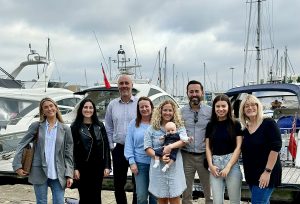
A solicitor at law firm Ellisons has qualified into its growing insolvency and debt recovery team. Cerys Gunn joined Ellisons in August 2021 and spent a year with the insolvency team during her training contract. Now a fully qualified solicitor, she is based at the firm’s Ipswich office. The appointment takes Ellisons’ insolvency and debt recovery team to seven fee earners; the largest specialist team in the region. Scott Porter, partner and head of the insolvency team, said: “The team’s size and expertise place it on par with much larger firms, enabling Ellisons to handle a diverse range of cases, from small insolvency matters to complex corporate recovery projects.”
Photo (l-r): Hannah Dersiley, Cerys Gunn, Adam McCaw, Tracy England, Lyndsey Squirrell, Scott Porter, Ellen Dearsley, Gillian Wright.
New lead partner at law firm

Law firm Irwin Mitchell has appointed Guy Forster (right) as its regional lead partner for East Anglia to drive growth and boost collaboration in the region. The full-service firm has opened new offices in Brighton, Cardiff, Liverpool and most recently Nottingham. It passed £300m revenue for the first time in 2024.
Private bank appoints senior relationship manager

Private bank Hoare & Co. has appointed Mark Gaisford as a senior relationship manager to lead its team in the East of England. He will be based in Essex and also cover Suffolk and Hertfordshire. He joins from Coutts & Co where he was a director, private banking and has over 15 years working in the sector in London and the East of England advising wealthy individuals and their families. Venetia Hoare said: “The region is home to leading agricultural and family owned businesses, landed estates and entrepreneurs who are a natural fit for us. We already enjoy strong relationships with customers in this part of the country and look forward to expanding our presence there.” The bank has recently made senior hires across the North, North West, South West and East of England.
New partnership aims to help school students practical and soft skills

Deloitte Cambridge and Castle Manor Academy in Haverhill have formed a new partnership as part of the firm’s 5 Million Futures programme. It is designed to help students with practical and soft skills as they move through secondary school into further education and employment. It will cover areas such as financial awareness, CV-writing, and job applications; as well as soft skills sessions on building confidence and interview skills. The programme will also work with governors, teachers and other school staff. Faye Dorsett, tax director at Deloitte who leads the programme, said: “We are thrilled to partner with Castle Manor Academy and are excited to use our skills to make a real difference to the young people in our local community.”
Cambridge company supports men’s health initiative

Cambridge company Domino is supporting its employees in the annual Movember challenge – raising funds for medical research, life-changing health programmes and innovative treatments for men’s health issues. Over 35 Domino staff across the business have been walking, running or growing moustaches to spread the word and encourage donations which will tackle men’s mental health, suicide, prostate cancer and testicular cancer. Horatiu Busca, the Do Movember team captain, said: “Once again the Domino team has been tackling the Movember challenge, raising funds for this very worthwhile initiative with sporting activities or sporting a moustache for the month of November. We’ve already smashed our target of £1,500 and are on track to double it by December.”