Business outlook brightens for second half despite dip in activity
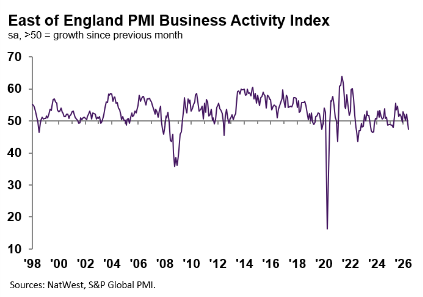
The outlook amongst private firms in the East of England’s improved in June as inflation eased despite a weakening in output, new orders and employment during the month. Input price and charge inflation both eased further to reach three-month lows and overall confidence was the highest since February, before the Middle East war started. Hopes for growth were linked to an end to the war, investment, diversification, marketing, stronger sales pipelines, contract wins and higher exports. But the NatWest East of England growth tracker business activity index fell to 47.4 in June, from 48.9 in May, the first ‘back-to-back declines’ for over a year. Meanwhile, the rate of job shedding was the fastest since March. Lisa Phillips, regional managing director, Midlands and East, commercial mid markets at NatWest, said: “Current business conditions in the private sector economy of the East of England remained challenging in June… But other survey indicators provided much more encouraging news on the prospects for the second half of 2026.”
New £18 million centre opens in Suffolk to ensure businesses are ‘equipped’ for economic change

A new £18 million skills and innovation centre opened in Stowmarket last week with ambitions to create a ‘new gateway to growth’ in sectors such as AI and digital tech for businesses in Suffolk and the wider region. Over 100 local business people and officials attended the event for Mid Suffolk District Council’s Stowmarket Innovation Gateway. It will offer office spaces for start-ups, collaboration and innovation areas, meeting rooms, a café and training spaces. The hope is that by connecting local firms, education providers and innovation specialists, the centre at Gateway 14 will help businesses take advantage of opportunities in clean growth, digital technology and artificial intelligence. The centre, which was backed by £16.66 million of funding from the Freeport East low tax zone, will offer professional development courses, spanning AI, digital, leadership and creative disciplines. They will be delivered on-site by West Suffolk College, Suffolk New College and the University of Suffolk and aim to address skills gaps in the region. Cllr Richard Winch, cabinet member for housing and property at the council, said: “The Stowmarket Innovation Gateway was designed with growing sectors such as the green economy and digital/AI technology at the heart. Its mission is to help ensure that businesses and individuals in the area are not left behind by the next wave of economic change but are instead equipped to shape and build it.” The building, which was delivered by Wilten Construction and Jaynic in partnership with Gateway 14, meets a BREEAM excellent rated standard and includes a green roof and solar panels.
Growth in region’s mid-market sector gathers pace in uncertain times
The East of England has seen some of the strongest growth of any UK region in the number of mid-market businesses, according to new data. Despite uncertain economic times, the number of firms trading in the East in the £10-500 million-turnover bracket has risen by 5.4 per cent to over 3,000 businesses, outperforming the national increase of 4.4 pc. Figures from BDO also show that businesses in the East lifted turnover by 4.8pc to £180 billion and supports more than 850,000 jobs across the region. Peter Harrup, regional managing partner at BDO in East Anglia, said: “The mid-market has huge growth potential. These businesses create high-quality jobs, deliver local investment, and drive innovation, and it is particularly encouraging to see the number of these businesses expand in East Anglia, defying challenging conditions. Where some sectors’ growth is stagnating, it is essential that we listen to the signals and provide them with the support they need to make sure we are not holding back this engine of the economy.” To boost growth amongst firms in the sector, BDO is calling for action on skill shortages, a “clearance-style” apprenticeship scheme and support for SMEs to offer young people work experience.
Stansted Airport ramps up work on new facilities

London Stansted Airport is accelerating work on its ‘transformation programme’ that will deliver new passenger facilities, support growth and unlock spare capacity on its existing single runway. Since unveiling plans in October 2024, Stansted has been developing designs and doing enabling works, which will boost its terminal capacity to more than 40 million passengers pa in coming years. Work starts this summer on new “skylink” walkways to connect the terminal to existing satellite buildings so the airport’s track transit people-mover system can be be decommissioned. A three-bay extension to the existing terminal will add 16,500 sq m of space with new shops, bars and restaurants and make Stansted the biggest single terminal airport in Europe. The airport’s managing director Gareth Powell said: “We have real momentum behind our vision for London Stansted and a strong platform to build upon having joined the big league of airports last year when we passed the 30m passengers a year milestone and securing planning permission to serve up to 51m passengers a year.” Meanwhile, Stansted has had a strong start to the year with a record June that saw passenger volumes up 3.4pc year-on-year at 2.88m.
Photo: A CGI of the extended terminal at Stansted Airport.
Financial planning firm expands with move to larger Suffolk office
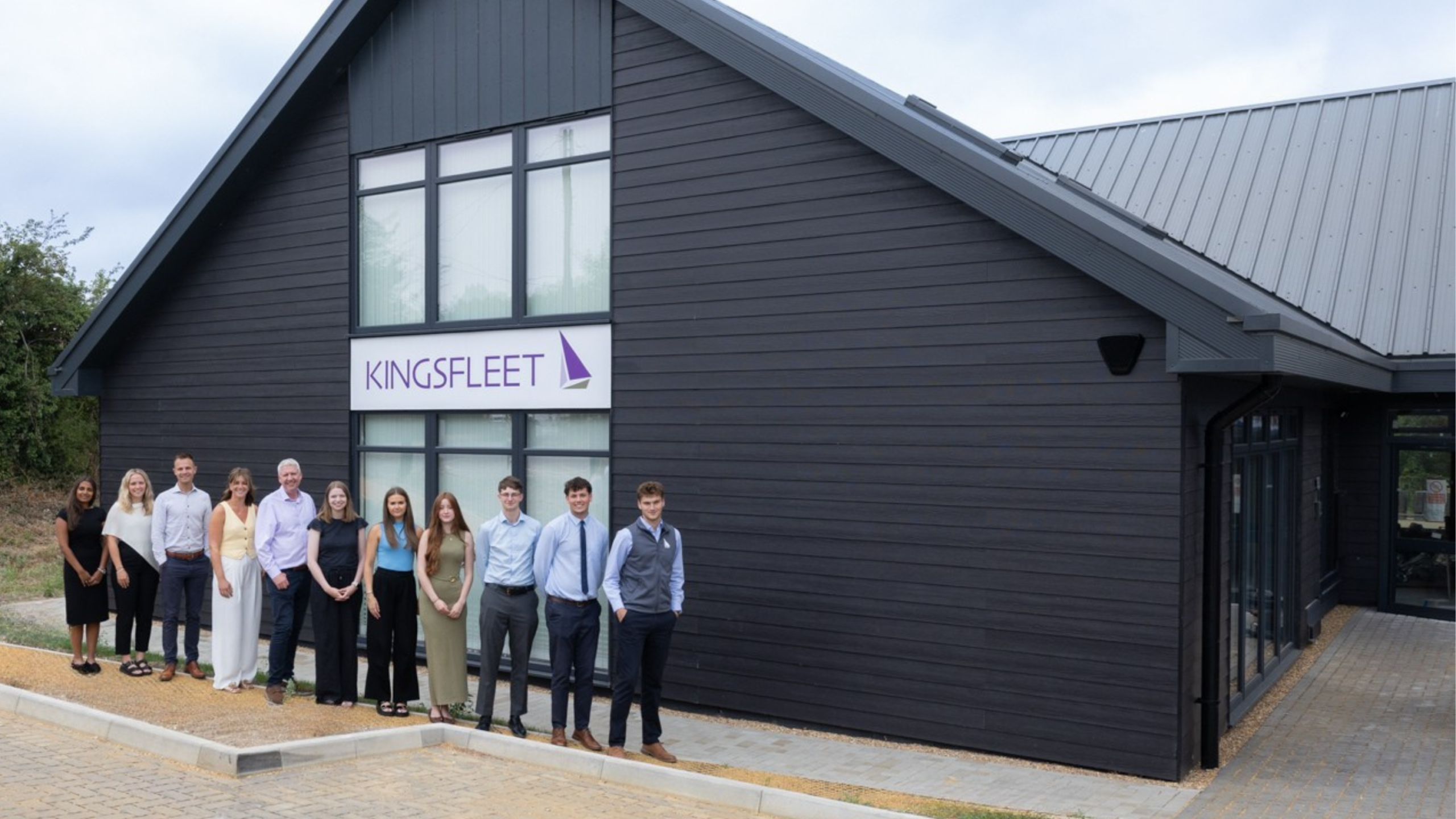
Financial planning firm Kingsfleet has relocated to larger officed in Claydon, near Ipswich as part of its continued growth and long-term investment. The business has moved into Deben House at Opus Park, increasing its office space by a half to 1,800 sq ft. The new premises will provide improved facilities for both clients and employees, including three meeting rooms, kitchen facilities and disabled access. It follows the recent opening of Kingsfleet’s office in Thurston, near Bury St Edmunds. Managing director Colin Low said: “Moving into a larger office is an important step for Kingsfleet and reflects the strong growth of the business over recent years. We wanted to create a space that works better for both our clients and our team, with room to continue developing in the future.”
Three new partners join growing law firm

Law firm Ashtons Legal has appointed three new partners with wide experience as the firm continues its strategic growth across the East of England. Zoe Hodge joins Ashtons’ nationally-recognised Court of Protection team. She specialises in helping vulnerable individuals and their families manage complex financial and legal affairs and acts as a deputy for a number of clients and advises attorneys and lay deputies. David Marsh joins the commercial property team in Suffolk with expertise in acquisitions and disposals, development projects, landlord and tenant matters, property finance, promotion agreements, overage arrangements and mines and minerals. Meanwhile, Mark Wrinch joins the firm’s property disputes team in Suffolk, advising on residential, commercial and agricultural property disputes. He is a member of the Property Litigation Association, Agricultural Law Association, Country Land and Business Association and the Suffolk Agricultural Association. Ashtons Legal CEO James Tarling said: “All three are joining busy and successful teams and bring a wealth of experience and a strong reputation in their respective fields. These partner appointments further strengthen our offering to clients and reflect our commitment to investing in exceptional talent as we continue to grow across the East of England.”
Photo (l-r) : James Tarling, Zoe Hodge, David Marsh, Mark Wrinch.
Supportive workplaces inspire green actions by employees
Employees are more likely to take ‘meaningful action on sustainability’ when they feel supported by their employer and managers, according to new research by the University of East Anglia. The study of more than 400 workers in the UK and US, found that positive workplace relationships play a key role in encouraging environmentally-friendly behaviour on the job. Support from an organisation as a whole is particularly effective at inspiring larger, more complex actions that can make a big difference. Lead author Dr Duncan Maguire, from UEA’s Norwich Business School, said: “Even with limited resources, organisations can meaningfully strengthen this behaviour by focusing on low cost relational and cultural levers. For example, taking time to communicate clearly and consistently the environmental goals and the progress being made.”
- Solid fundamentals against elevated market expectations
- Discover more insights in Brown Shipley’s latest market and investment update: Markets and Investment Update | 20 July 2026
- Investing puts your capital at risk