Start ups on the rise in the region as confident entrepreneurs launch new ventures
The number of start-up businesses launching in the region has increased despite higher interest rates and the arrival of the holiday season. Research from the Eastern branch of insolvency trade body R3 shows that East Anglian start-ups rose by 5 per cent last month, from 7,429 in June to 7,775 in July and in contrast to the same period last year when they fell. The monthly number of start-ups in the region has increased by over a half since the end of last year, when December saw just 5,010 businesses set up in the region. R3 Eastern chair Alistair Bacon, founding principal at AMB Law in Ipswich, said: “It’s evident that business confidence is still there in our region, despite sizeable economic challenges, not least yet another rise in interest rates. Some of the factors working in our favour are the lower cost of workspaces here compared to the capital, as well as strong professional sector support for key business sectors such as tourism, tech and agriculture. For start-ups having to be particularly careful with their finances, the East of England is an appealing economic option.” Meanwhile, the number of the region’s businesses facing late payments continues to fall but remains high at nearly 63,000.
New work private firms dips in July but employment rises ‘solidly’
Private business activity fell in July for the first since the start of the year and inflationary pressure picked up although employment rose solidly, according to a key survey of purchasing managers. The first reduction in new work seen this year was behind a dip in the NatWest East of England PMI business activity index to 49.5 in July from 51.8 in June and below the key no-change mark of 50 for the first time this year. Economic uncertainty, rising interest rates, a weak housing market and inflation all took their toll and the 12-month outlook weakened. But the decline in new business was marginal and in line with the UK trend whilst manufacturers and service providers saw falling demand in July at similar rates. Private firms in the East also remained confident of increasing output over the next 12 months. Service providers saw stronger cost pressures than goods producers, mainly linked to wages. Average input prices in the East rose at the highest rate for three months and prices charged by firms rose for the 37th month running. Rashel Chowdhury, NatWest Midlands and East regional board, said: “The July PMI data were largely disappointing with output and new orders both falling, and inflationary pressures rising…..Worryingly, input price inflation accelerated to a three-month high in July and was broadly in line with the average for the first half of 2023, adding to the sense that prices and interest rates will remain stubbornly high for longer than previously expected.”
Separately, cut-backs in customer spending are the biggest concern for more than half of East Anglian companies (55 per cent) over the next six months, alongside rising interest rates and the cost of borrowing (32 per cent) according to BDO’s bi-monthly economic engine survey of 500 mid-market businesses. Supply chain issues such as delayed deliveries, stock shortages and cost increases, are also a significant headache for businesses.
Record July takes London Stansted passenger numbers above pre-pandemic levels

The start of the holiday season saw the busiest-ever July at London Stansted, making it the first major UK airport to see passenger numbers above pre-Covid volumes. More than 2.8m passengers passed through its terminal in the month, up 13 per cent on the month last year and equal to 102 per cent of the figure for July 2019. Dublin was the most popular destination in July followed by Istanbul and Palma. A total of 97,000 passengers travelled through the airport on July 31, making it the airport’s busiest day of the year so far. The month also saw the 80th anniversary of Stansted’s runway and US president Joe Biden’s arrival on Air Force One ahead of an audience with the king. Gareth Powell, London Stansted managing director, said: “This performance reflects our position as the number one airport in the UK for direct flights to Europe, as well as the great value, convenience and service we offer to passengers. Our summer getaway has got off to a very strong start thanks to the hard work and dedication of our colleagues and great collaboration with all our airport partners.
Photo: Air Force One at London Stansted recently.
New marketplace for Norfolk SMEs to be introduced at B2B Exhibition
The Norfolk Chambers of Commerce is introducing a new ‘B2B Marketplace’ providing smaller businesses more opportunities at its 25th Year B2B Exhibition at the Norfolk Showground on 12th October. “We are thrilled to commemorate our 25th year of the B2B Exhibition which highlights the resilience and strength within the Norfolk business community,” said Nova Fairbank, CEO of Norfolk Chambers of Commerce. “This year, we are excited to introduce the B2B Marketplace, providing smaller businesses more opportunities for connections and growth.” The chamber says the new initiative is set to revolutionise the exhibition, featuring a curated space for smaller businesses and charities to showcase their products and services. It will enhance networking possibilities and provide attendees with a comprehensive overview of the region’s diverse business landscape. For sponsorship opportunities and exhibition stand bookings, get in visit the website here.
Investor group takes control of Newmarket-based horticultural supplier
Harwood Capital Management, a private equity investor in SMEs, has increased its stake to take full control of the group that owns Newmarket-based horticultural supplier Mr. Fothergill’s Seeds. Founded in 1978, Mr. Fothergill’s Seeds owns/operates multiple brands, supplying over 5,000 garden centres and retailers in the UK and through online and direct to consumer channels. It has been operating in Australia and New Zealand since 1989 and supplies Canada, Europe and the Middle East. In February last year, Harwood backed the MBO of the business, taking a material minority stake to support future growth. Following an initial period of post-deal transition and investment, Harwood is assuming control and CEO Dave Carey, the son of one of the original founders, is leaving. Trevor Parker, a specialist adviser to private equity-backed firms who had previously spent several months in the business, is returning to provide operational and strategic support to the management team. He said: “The Mr Fothergill’s Seeds family comprises a fantastic team of highly knowledgeable and experienced employees. I built a very close working relationship with them during the time I have already spent in the business. I look forward to building on that as we launch exciting new products and implement new systems and technology across the group.”
Dave Carey said: “I am proud of the part I have played in a business which has grown into the international operation it is today. However, after twenty-three years at Mr. Fothergill’s Seeds I now feel the time is right to leave, secure in the knowledge that the group is in the experienced hands of people who share the values that have underpinned its success to date.”
Stake in recruitment business sold to management team whilst founder retains equity position

Forward Corporate Finance, which is based on the Essex/Herts border, has advised Mark Shields, majority owner of London-based recruitment business Vantage Market Entry, on selling a stake to his management team. The deal sees partners Patrick Sim and Jack Knowles take meaningful stakes in the business. It also enables two other team members to secure minority stakes, with Mark Shields retaining an equity position. The deal also paves the way for new partners to take a stake in the business in the future. Based in Kensington, Vantage Market Entry specialises in the movement of senior executives and teams between leading global firms in management consulting, private equity and corporate markets, with a focus on the US. The business was founded in 2001 by Mark Shields following the sale of a majority stake in his previous company, Corporate Executive Search, which became the first head-hunter to float on the London Stock Exchange in 1998. Rob Dukelow- Smith, director at Forward Corporate Finance, said: “Mark initially spoke to us about a common question for owner managers of businesses, wondering how he can commence his eventual exit from Vantage, ensuring that the business carries on without him once he has fully departed, but whilst staying involved in the leadership and daily client facing role that the business can’t currently do without. An MBO can be deliberately staged exit planning that enables the younger team members to step up, whilst still retaining the guidance and knowledge of the founder and focusing that team on real ownership in the future, a genuine incentive.”
Mark Shields said: “Rob and Will have provided excellent support to me throughout this transaction. The advice I received at the outset in relation to deal structuring was of the highest quality and the project management that followed helped all parties to move together to overcome any challenges faced to reach completion.” Legal advice for Vantage was provided by Tracey Dickens at Birkett Long, and for the management team by Mark Stigwood at Attwaters, with tax advice from James Boustead at Rickard Luckin and David Richardson at Croucher Needham.
See Profile Forward Corporate Finance
Suffolk firms join forces in distribution partnership for cider-maker

Molson Coors Beverage Company has awarded a new five-year distribution contract for its Aspall Cyder brand to Suffolk logistics company Bartrums. Family-owned Bartrums, based in Eye, will be responsible for the UK outbound transport, factory clearance, storage and co-packing operations for the Aspall brand. The tie-up between the two Suffolk businesses – which employ a combined 370 people – will produce and distribute over 28 million litres of the dry, east-coast style cider and vinegar across the UK annually. Bartrums has recently completed a £7 million investment involving a new 70,000 sq ft fully racked warehouse and two-storey office block at its hq, eight miles from the Aspall Cyder house. Roisin Carr, regional operations director at Molson Coors Beverage Company, said: “We’ve continued to invest in the Aspall brand and the Aspall Cyder house, and like us, Bartrums is committed to its own growth while maintaining a strong presence in its home county.” The new contract follows a £13m three-year investment in the Aspall Cyder house, completed in 2022 and the brand’s first ever tv advert.
Norfolk farmer donates 90,000 sunflowers to help raise funds for new hospice
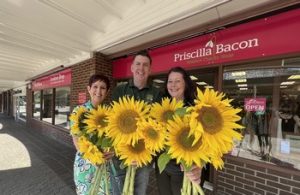
A Norfolk farmer has donated his entire crop of 90,000 sunflowers to help raise money for the Priscilla Bacon Hospice Charity, who are fundraising to build the new Priscilla Bacon Lodge, a new hospice close to the Norfolk & Norwich University Hospital. Rob Alexander, who farms land in south Norfolk, grew the crop after being inspired by the sunflower fields of Tuscany. He has donated the sunflowers to his partner Trina Beare, managing director of Norwich-based industrial supplies company Lamberts, who is using them as part of a corporate fundraising pledge to the hospice charity. Trina Beare said: “The team has been fundraising in a range of ways, including sponsored bike rides, bumble bee seed bombs and football squares. We’ve already raised over £1,000, but we wanted to do something to share some sunshine in people’s lives. The sunflowers were an obvious choice, and it is so fantastic Rob has donated them. They have been selling like hotcakes, but we still have many stems to sell.”
Jordan Codling, head of retail for the Priscilla Bacon Hospice Charity, added: “The sunflowers are a brilliant idea and Lamberts have had a real passion to raise as much as they can for our new building.” The sunflowers are being sold for a suggested donation of £1 per stem, across the Priscilla Bacon Hospice Charity’s nine shops: Anglia Square Norwich, Aylsham, Bowthorpe, Cromer, Drayton, North Walsham, Sheringham, Stalham and Taverham. Earlier this year, the charity launched its 500 Club, an initiative that over 150 local businesses have joined, to help raise the final £250,000 needed to complete the new facility.
Photo: Trina Beare, MD Lamberts (right) Rob Alexander, farmer (centre) and Sue Bird, store manager Priscilla Bacon, Bowthorpe (left).
Cambridge company works to improve plastic bottle recycling by removing the need for labels

Cambridge company Domino Printing is working with global beverage brands to develop sustainable coding solutions for PET plastic bottles and explore ways to improve recycling by removing the need for labels. The development is gaining popularity among drinks manufacturers as labels can interfere with the recycling process and lead to bottles creating plastic waste. The company is using its laser and high-definition ink coding systems to create alternative approaches to meet regulatory labelling requirements and provide consumer information. Russell Wiseman, head of global beverage solutions, Domino Printing, said: “When a PET beverage bottle ends up in a recycling plant, the label attached to it isn’t usually recycled. In fact, external labels can sometimes interfere with the usual processes and lead to bottles being removed from the recycling stream. For bottles sold in multipacks, it may be possible to include compulsory labelling on secondary packaging, removing the need for coding on individual bottles, but bottles sold individually are somewhat more challenging. That’s why we are working with leading beverage players to explore alternative ways to enhance sustainability.”